Two topics travellers constantly ask about but rarely find properly explained: the malta flag and the culture behind it. The flag of malta is unusual — white and red with a small George Cross in the top left corner, a direct reference to World War II. And Maltese culture is a properly fascinating mix of Arabic, Italian, British and Sicilian influences on a sun-baked limestone rock in the middle of the Mediterranean. This guide covers both: the flag’s meaning and history, then the actual living culture — language, religion, food, festas, traditional clothing, and what you’ll actually see and hear walking around Valletta or a Gozo village.
The Malta Flag — Meaning, Colours & the George Cross
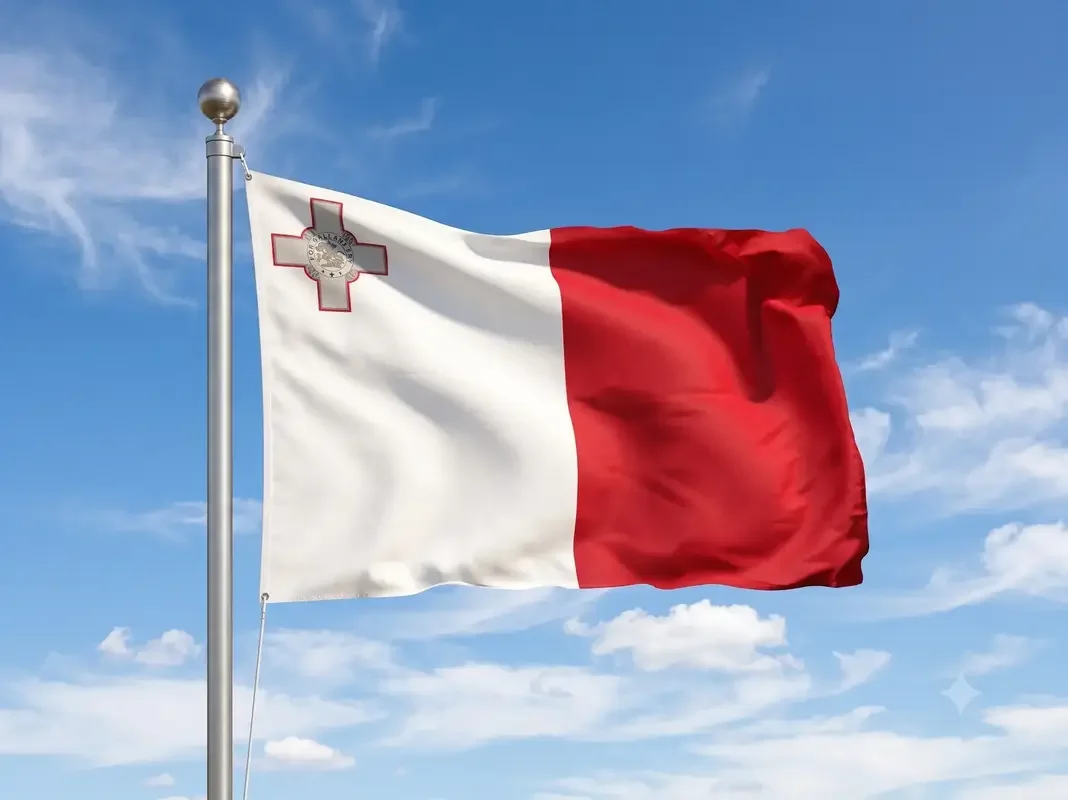
The flag of malta is simple visually but carries more history than almost any other national flag in Europe. Two vertical stripes — white on the hoist (left) side, red on the fly (right) side — with a grey-bordered George Cross in the upper hoist corner. That’s the malta country flag in its entirety: no coat of arms, no complex heraldry, just two colours and one very meaningful medal.
What the Colours Represent
The white and red of the maltese flag are traditionally linked to Count Roger I of Sicily, who conquered Malta from the Arabs in 1091. According to legend — not fully verified historically — Roger gave his red-and-white banner to the Maltese as thanks for their help. Historians now consider this largely mythological, but the colours have been Malta’s national colours for centuries regardless of their precise origin. The current proportions — 1:2 ratio — were officially set in 1964 at independence.
The George Cross Explained
The small cross in the upper hoist corner is what makes the malta flag meaning truly remarkable. It represents the George Cross — Britain’s highest civilian gallantry honour — which King George VI awarded to the entire population of Malta on 15 April 1942. The malta george cross recognised the Maltese people’s endurance during the brutal Axis bombing campaign of World War II, which nearly starved the island into surrender but failed.
The award of the george cross to malta came with a personal letter from George VI: “to bear witness to a heroism and devotion that will long be famous in history.” When Malta became independent in 1964, the george cross malta was incorporated directly into the new national flag as a permanent tribute. The malta gc on the flag is unique — it’s one of only two national flags in the world to feature a British gallantry medal.
Malta Flag History
Quick timeline of malta flag history:
- 1091-1530 — various feudal and dynastic flags under Norman, Hohenstaufen, Angevin, Aragonese and Castilian rule
- 1530-1798 — Knights of Malta era; the knights of malta flag (white cross on red) was used alongside civil ensigns
- 1798-1800 — French tricolour during Napoleonic occupation (british malta flag replaced this when Britain took over)
- 1800-1964 — Maltese civilian flag (red and white) used alongside the British Union Jack as colonial flag
- 15 April 1942 — george cross malta awarded to the entire population by King George VI
- 21 September 1964 — independence; current national flag malta adopted with George Cross added to the red and white design
- 1988 — minor modification to the cross’s grey border, still in use today
What Is the Malta Flag Dragon?
Malta flag dragon is one of the most-searched questions about the Maltese flag — and the answer is that there is no dragon on the official malta national flag. The confusion likely comes from the Maltese cross design, which can look dragon-like in some decorative versions, or from the historical flags of the Knights of Malta which sometimes incorporated heraldic animals. The official malta flag has only two elements: white and red stripes plus the George Cross. No dragon, no animal, no coat of arms.
The Maltese Cross vs the Malta Flag Cross
Many people confuse the maltese cross flag with the cross malta flag. These are different things. The maltese cross — the famous 8-pointed cross — is the symbol of the Knights Hospitaller (Order of Malta), with eight points representing the eight nations of the Knights. The cross on maltese flag (the George Cross) is an entirely different cross — it’s a plain Greek cross in silver grey. The flag with maltese cross people often imagine doesn’t exist as an official national flag — the flag of malta has a George Cross, not a Maltese cross.
Malta Cultural Identity — A Mediterranean Mix
Start with geography. Malta sits 80 km south of Sicily and 280 km north of Africa. Seven thousand years of waves of settlers — Phoenicians, Romans, Arabs, Normans, Spanish, Knights, French, British — each left something behind. The result is a malta culture that doesn’t neatly fit into any single European box.
Walk around Valletta and you’ll hear Maltese (a Semitic language), see Baroque architecture (Italian), drink afternoon tea (British), eat ricotta-filled pastries (Sicilian), and watch a Good Friday procession that would be at home in southern Spain. That’s maltese culture in one snapshot.
Five threads run through everything:
- Mediterranean family-centricity — multigenerational households, long Sunday lunches, everyone knows your cousin
- Deep Catholic religion — 98% baptised, 350+ churches on the islands, big public festas
- British institutions — driving on the left, English-language schooling, pub culture in some towns
- Italian influences — food, fashion, Catholic processions, Italian television widely watched
- Island mentality — everyone knows everyone, small-community networks, genuine maltese hospitality
Language in Maltese Culture
Maltese (Malti) and English are the two official languages, and about 88% of the population speaks both. Maltese itself is the most unusual part of the culture of malta — the only Semitic language in the EU, written in Latin script, descended directly from the Arabic spoken on the island from 870 to 1091. About 40% of modern Maltese vocabulary is Arabic in origin, 40% Italian/Sicilian, and 20% English.
→ Full guide: What language do they speak in Malta
Religion & Festas
Malta is one of the most Catholic countries in the world by percentage of population. Roughly 98% of the island is baptised Catholic, though regular mass attendance has dropped to around 40-50% in recent decades. Religion isn’t just private — it’s woven into the calendar, public life and architecture.
The most visible expression is the festa. Every village has a patron saint, and every summer that village throws a multi-day festival in their honour. Streets get decorated with massive silk banners, church facades get lit up with thousands of coloured bulbs, brass bands march, statues of the saint are paraded on the shoulders of villagers, and everything ends with serious fireworks. Maltese village life revolves around the każin (village band club) and the parish church — the two institutions that have defined community identity for centuries. Każin malta meaning: każin literally means “casino” in Maltese, but refers to the band club building where locals socialise, play cards and organise the village festa.
If you’re visiting between June and September, there’s a festa happening somewhere almost every weekend. Highlights:
- Mnarja (29 June) — ancient folk festival celebrated in Buskett Gardens
- Santa Marija (15 August) — the biggest festa day, national holiday, multiple village celebrations
- Good Friday — solemn processions across the country, life-size biblical statues carried through streets
- Carnival (February) — colourful pre-Lent celebration, floats, costumes, parties in Valletta and Nadur (Gozo)
Maltese Food Culture
Maltese food is Mediterranean with British quirks and Arab foundations. Key things to try:
- Ftira — Maltese sourdough bread, often made into an open-faced sandwich with tuna, olives, capers, tomatoes
- Pastizzi — diamond-shaped pastries filled with ricotta cheese or mushy peas, €0.50-1 each
- Fenkata — rabbit stew cooked slowly in red wine, garlic and herbs. The traditional Sunday meal and national dish
- Bragjoli — beef olives stuffed with minced meat, eggs, parsley and cheese, simmered in tomato sauce
- Lampuki pie — seasonal autumn pie made with dolphin fish (the fish, not the mammal)
- Cisk — local lager, brewed on the island since 1929
- Kinnie — bitter-orange soft drink, unique to Malta, worth trying once
Traditional Maltese Clothing & Crafts
Traditional maltese clothing centres on the għonnella — a black silk hooded cloak worn by Maltese women for centuries. The għonnella (sometimes spelled ghonella) was a practical garment that served as a veil, shawl and hood in one. While almost no one wears it daily anymore, it’s still seen at traditional celebrations and in museums, and has become an important cultural symbol.
Other distinctive Maltese crafts and symbols:
- Maltese filigree — delicate gold and silver lacework jewellery, often incorporating the Maltese cross. The village of Ta’ Qali is the main centre for maltese cross jewellery and filigree artisans. The 8-pointed Maltese cross in jewellery form has been made on the island since the Knights era
- Maltese lace — intricate handmade lace (bizzilla), traditionally made by Gozitan women, now increasingly rare but still found in craft shops
- Luzzu boats — brightly painted traditional fishing boats with an eye painted on the prow. The eye (the eye of osiris malta connection is debated — it’s more likely Phoenician in origin than Egyptian) is believed to ward off evil and protect fishermen at sea. Best seen at Marsaxlokk harbour on Sundays
Maltese Etiquette & Social Life
A few things worth knowing for visitors on maltese lifestyle and social customs:
Tipping in Malta restaurants: tipping is appreciated but not mandatory. The standard for malta tipping culture is 10% for good restaurant service if no service charge is included. Check your bill — some restaurants add 10% automatically. For taxis, rounding up is the norm. No tipping expected at bars for single drinks.
Dress code for churches in Malta: shoulders and knees must be covered to enter any church. This applies even in summer heat. Most churches have shawls or covers available at the entrance for tourists who arrive underdressed. Festas are more relaxed — you can watch street processions in casual clothes.
Maltese people personality: generally warm and hospitable to visitors, with a strong sense of community and family loyalty. Direct communication is common — Maltese people say what they mean. Small talk at a bar or café is completely normal even with strangers. English is spoken widely and confidently.
Music, Folklore & Traditions
Malta’s musical heritage is dominated by għana — a traditional folk singing style where performers improvise lyrics in competitive exchanges. Think Italian cantastorie meets spoken-word battle. Real għana is becoming rarer but still appears at festivals. Maltese wedding traditions blend Catholic ceremony with extended family celebrations that often last well into the night, with traditional music, dancing and multi-course Maltese meals. Maltese superstitions include the evil eye (il-għajn) — a belief in protective amulets and the power of envy to cause harm, a belief shared across the Mediterranean and Middle East.
Family, Village Life & Modern Malta
Traditional family structures remain strong — maltese lifestyle centres on family in a way that surprises many visitors. Multiple generations often live near each other or in the same building. Sunday lunch at Nanna’s (grandmother’s) house is near-universal. That said, the last 20 years have been a period of extreme rapid change. EU membership in 2004, the Euro in 2008, and a booming iGaming / blockchain / financial services sector brought huge waves of foreign workers. The population grew from 400,000 in 2004 to over 550,000 today, with roughly 25% of residents now foreign-born.
How to Experience Maltese Culture as a Visitor
- Hit a village festa — any weekend from June to September, ask your hotel or check parish noticeboards. Free to attend
- Eat at a proper “ta'” restaurant — names starting with “Ta'” (meaning “of” or “belonging to”) are often family-run traditional spots
- Marsaxlokk Sunday fish market — traditional luzzu boats in the harbour, fresh catch, proper Maltese brunch food stalls
- Gozo for a day — the quieter island preserves village culture most intact
- Good Friday processions — if visiting around Easter, watch a village procession. Solemn, emotional, genuinely medieval in feel
- Carnival week (February) — Nadur (Gozo) for anarchic authentic carnival; Valletta for polished floats
- Ta’ Qali crafts village — watch artisans make Maltese filigree, glassware and maltese cross jewellery in traditional workshops
For organised cultural tours and experiences, browse our Malta activities directory. For a week combining culture, beaches and nightlife, our complete Malta holidays guide shows how to do it all.
FAQ — Malta Flag & Culture
What does the Malta flag look like?
The malta flag has two vertical halves — white on the left, red on the right — with a grey-bordered George Cross in the upper hoist corner. Clean, simple, instantly recognisable. The maltese flag has no dragon, no coat of arms, no animal — just red, white and the George Cross.
What is the meaning of the Malta flag?
The malta flag meaning: red and white are traditional national colours linked (mythologically) to Count Roger I of Sicily (11th century). The George Cross in the corner represents Britain’s highest civilian gallantry award, given to the entire population of Malta on 15 April 1942 for heroism during WWII bombing. The maltese flag meaning is essentially a tribute to WWII sacrifice permanently incorporated into the national identity.
Why is there a cross on the Malta flag?
It’s the George Cross — a British civilian gallantry medal — awarded to Malta’s entire population by King George VI in 1942 for endurance during Axis bombing. The cross on maltese flag was added when Malta became independent in 1964 as a permanent tribute. The maltese cross on flag question confuses many — the cross on the flag is a George Cross, not a Maltese cross (which is the 8-pointed Knight’s cross).
Is there a dragon on the Malta flag?
No. Malta flag dragon searches are common but the official flag of malta has no dragon. This confusion may come from decorative or heraldic versions of Maltese symbols seen online. The official national flag has only two elements: red and white stripes plus the George Cross.
What is the Maltese cross?
The Maltese cross is the 8-pointed cross symbol of the Knights Hospitaller (Order of Malta). Its eight points traditionally represent the eight nations (langues) of the Knights. It’s used in maltese cross jewellery, on the Order of Malta’s flag, and in many decorative contexts — but it does NOT appear on the official malta country flag, which has a George Cross instead.
What is the Malta flag with a cross called?
The flag with maltese cross most people picture is actually the flag of the Order of Malta (sovereign military order) — a white Maltese cross on red. The official maltese flag of the Republic of Malta has a George Cross (not a Maltese cross) in the top left corner on a white and red background.
What is Maltese culture like?
Malta culture is a mix of Mediterranean, Arabic, Italian and British influences — Catholic, family-centric, food-focused, with strong village traditions (festas, brass bands, fireworks). The maltese lifestyle is warm and community-oriented, with English spoken widely alongside Maltese. Maltese hospitality is genuine — locals are generally friendly and direct with visitors.
What is tipping etiquette in Malta?
Tipping in malta restaurants: 10% is standard if no service charge is included. Check your bill first. Malta tipping culture is relaxed — tipping is appreciated but never aggressive or expected for basic service. Taxis: round up. Bars: not expected for single drinks.
What should I wear to visit a church in Malta?
Dress code for churches in malta: shoulders and knees covered, for all genders. This is enforced at most major churches including St John’s Co-Cathedral in Valletta. Most entrances have shawls or covers available for tourists who arrive underdressed.
What is the national dish of Malta?
Fenkata — slow-cooked rabbit stew with red wine, garlic and herbs. Pastizzi (ricotta or mushy pea pastries) are the national snack, sold at pastizzerias across the island for €0.50-1 each.
→ Want to combine culture with beaches and nightlife? Check our complete Malta holidays guide