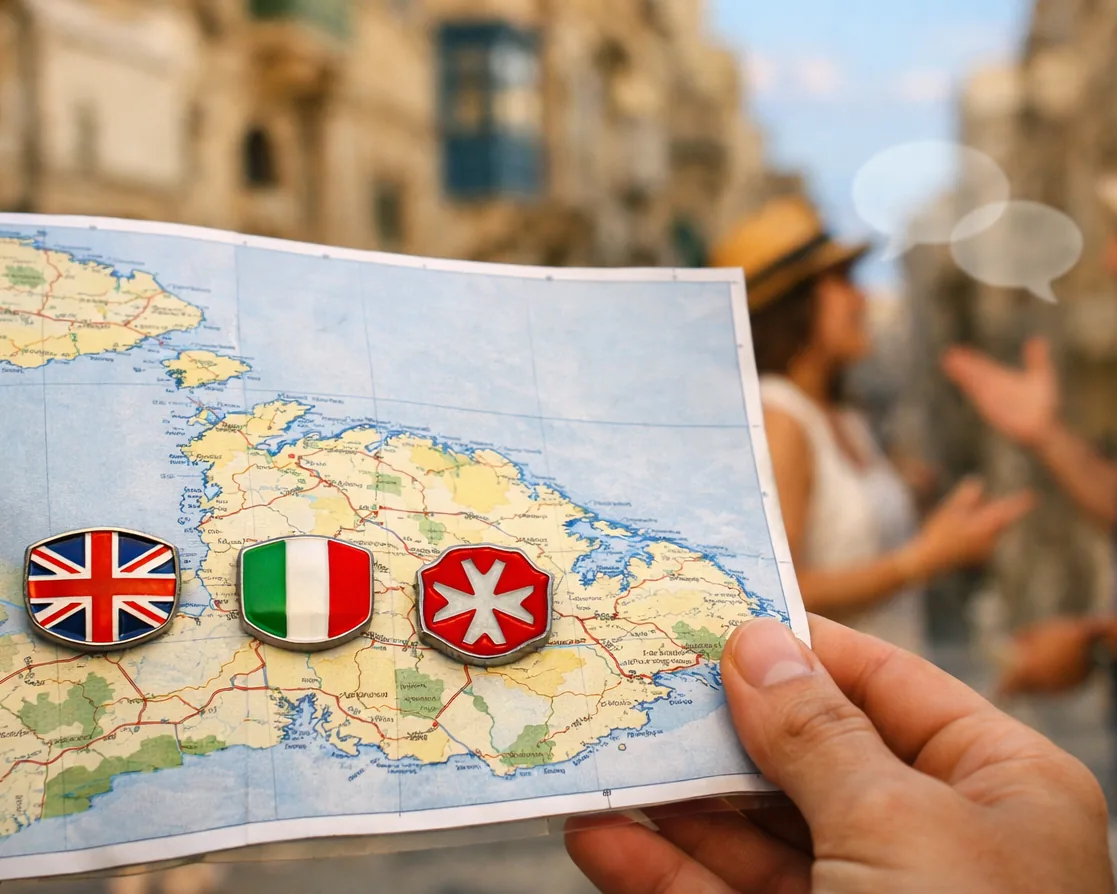
Malta has two official languages: Maltese and English. The language spoken in Malta day-to-day is a fascinating mix — a 1,000-year-old Arabic-rooted tongue written in Latin script, blended with Italian, English, and a dash of French. The good news for visitors: 96% of the population understands English, making Malta one of the most accessible countries in Europe. Here’s everything you need to know about the language in Malta — from its unique history and alphabet to the words that will get you free drinks at the bar.
What Language is Spoken in Malta? The Quick Answer
The official languages of Malta are Maltese (Malti) and English. Maltese is the national language of Malta, enshrined in the Constitution since 1964 — in any conflict between the two official texts of a law, the Maltese version takes precedence. English has been co-official since the British colonial era and remains the language of business, education, and tourism across the island.
In practice, the main language of Malta depends on context. In the private sphere — at home, with friends, in local bars — Maltese dominates. In tourist areas, hotels, restaurants, and any formal setting, English is the default. Most Maltese people switch fluently between both in the same conversation, a local phenomenon called Maltenglish.
Does Malta Speak English? The Stats
Yes — and at a level that surprises most visitors. According to a 2022 national survey of 130,000 people, 96% of residents in Malta understand English. The Eurobarometer places Malta at 89% for conversational English — second only to the Netherlands in Europe. English is taught from age 3, it’s mandatory throughout schooling, and it’s the primary language of the University of Malta. In St Julian’s, Sliema and Valletta, English is essentially the first spoken language in most public interactions.
So: does Malta speak English? Absolutely. You will never be stuck anywhere in Malta for not speaking Maltese.
Malta Language — A Unique Story in Europe
The Maltese language holds a remarkable record: it is the only Semitic language in the world written in the Latin alphabet, and the only language of Arabic origin that is an official language of the European Union. Malta’s European language status — as a full EU member since 2004 — means Maltese is one of the EU’s 24 official languages, with all European legislation translated into it. Not bad for a language spoken by around 530,000 people worldwide.
Malta Language Origin and History
The origin of the Maltese language traces back to 870 AD, when Arab forces from North Africa conquered the island and implanted Siculo-Arabic, a dialect of Maghrebi Arabic. When the Normans retook Malta in 1091, they let the population keep speaking as they did — and the language began absorbing influence from each successive ruler: Normans, Sicilians, the Knights of St John (who brought Italian and French), and finally the British (who brought English).
The Malta language history took a political turn in the early 20th century. Until 1934, Italian — not English — was Malta’s third official language, used by the educated elite in courts and administration. The British, wary of Mussolini’s influence, removed Italian from official status in 1934, cementing the Maltese-English duo that exists today. The debate over which language should dominate — known as the Kwistjoni tal-Lingwa (the Language Question) — raged for over a century and shaped Maltese national identity.
Malta Language Percentage — Where Do the Words Come From?
The vocabulary of the Malta country language breaks down as follows, based on analysis of the 41,000-entry Aquilina dictionary:
| Origin | Share of vocabulary | Role |
|---|---|---|
| Italian / Sicilian | ~52% | Legal, religious, technical, administrative terms |
| Arabic / Siculo-Arabic | ~32% | Core grammar + everyday vocabulary (~60% of spoken conversation) |
| English | ~6–20% | Modern life, tech, business, youth slang |
| French & others | ~10% | Borrowings from Knights era and other influences |
Although Arabic represents only a third of the dictionary, it accounts for roughly 60% of daily spoken Maltese — because it supplies all the grammar and core vocabulary: dar (house), xemx (sun), omm (mother), ilma (water). Then Italian layers in with grazzi (thank you), English adds televixin (television), and French from the Knights of St John era sneaks in with Bonġu (good morning, from French bonjour) and Bonswa (good evening).
Languages Spoken in Malta Beyond Maltese and English
The languages spoken in Malta reflect the island’s position as a Mediterranean crossroads. Beyond the two official languages:
- Italian — understood by an estimated 62–66% of the population, largely thanks to decades of Italian TV channels received from nearby Sicily (93km away). Ironically, more Maltese understand Italian today than in 1931, when it was an official language.
- French — spoken by approximately 17–20% of residents, boosted by school curricula and the Alliance Française presence in Malta.
- German and Spanish — each understood by smaller percentages, mainly through tourism and education.
- Expat languages — with foreigners making up around 25% of Malta’s residents, Russian, Arabic, Romanian, and Serbian are also heard regularly in Sliema and St Julian’s.
For French and Italian speakers visiting Malta: slow down and you’ll likely be understood. For everyone else, the native language in Malta that gets you everywhere is English.
The Malta Language Alphabet — 30 Letters
The Malta language alphabet consists of 30 letters — the 26 standard Latin letters minus C and Y, plus six unique characters standardised in 1924 by the Akkademja tal-Malti. These special letters are what give written Maltese its distinctive look:
| Letter | Sound | Example |
|---|---|---|
| Ċ | “ch” as in church | ċirasa (cherry) |
| Ġ | “dj” as in jungle | Bonġu (good morning) |
| Għ | Silent — lengthens nearby vowels | għada (tomorrow) |
| Ħ | Strong breathed “h” from the throat | ħobż (bread) |
| X | “sh” as in ship | xemx (sun) |
| Ż | “z” as in zebra | żarbun (shoe) |
Malta Language Words — Essential Phrasebook for Visitors
You don’t need to speak the Malta language to have a brilliant trip. But these Malta language words will get you genuine smiles — especially useful in bars, at pool parties and beach clubs, or anywhere locals are around. Note: thank you in malta language is simply Grazzi — say it constantly and you’ll be loved.
| English | Maltese | Pronunciation |
|---|---|---|
| Good morning | Bonġu | BON-jou (like French “bonjour”) |
| Good evening | Bonswa | BON-swaa (French “bonsoir”) |
| Thank you | Grazzi | GRUT-si (Italian “grazie”) |
| Please | Jekk jogħġbok | YEK yoh-JBOK |
| Cheers! | Saħħa! | SAH-ha — also means goodbye and good health |
| Goodbye | Ċaw / Saħħa | TCHAW (casual) / SAH-ha |
| Yes / No | Iva / Le | II-va / LÉ |
| The bill please | Il-kont, grazzi | il-KONT GRUT-si |
| Beer | Birra | BIR-ra — order a Cisk, the local lager |
| Where is…? | Fejn hu…? | FEYN OO |
| I love Malta | Inħobb Malta | in-HOBB MAL-ta |
Pro tip: Saħħa covers three situations — toasting, saying goodbye, and wishing someone good health. One word, infinite usefulness. Drop it at the bar and watch the reaction.
Malta Language Schools — Learn English in Malta
Malta has built a serious reputation as a destination for English language learning, and the Malta language school sector is one of the island’s fastest-growing industries. In 2024, over 80,000 international students enrolled in Maltese language schools — a record. The island has 33–38 accredited schools regulated by the government’s ELT Council.
Malta language school prices are significantly lower than UK or Irish equivalents: a standard 4-week course (15 hours/week) costs approximately €600–1,000, compared to €1,000–1,600 in England. Combined with 300 days of sunshine, beaches, and a nightlife scene that runs all summer, it’s easy to understand why Malta attracts so many 17-25 year olds for language immersion. The top nationalities in 2024 were Italians (24.9%), French (10.3%), and Germans (10.1%).
Beyond the classroom, the Valletta Malta language experience is total immersion — English is everywhere, from street signs to menus to the club DJ’s announcements. Check Malta Fiesta’s events calendar to plan the non-classroom part of your stay.
FAQ — Language in Malta
What language do they speak in Malta?
Malta’s two official languages are Maltese and English. Maltese is the national language; English is co-official and understood by 96% of the population. Italian is also widely spoken as a third language by around 62–66% of Maltese people.
What language is spoken in Malta for tourists?
English is the language spoken in Malta for all tourist situations — hotels, restaurants, bars, transport, hospitals. You will never need Maltese to get around. That said, a few words like Saħħa and Grazzi will make locals warm to you instantly.
What is the official language of Malta?
Malta has two official languages: Maltese and English. Maltese is constitutionally defined as the national language and takes precedence in legal contexts. English is co-official and used across all public services, education, and business.
What language does Malta speak in everyday life?
In everyday private life, the main language Malta uses is Maltese — over 80% of conversations between locals happen in Maltese or a Maltese-English mix. In professional and tourist contexts, English dominates. Young Maltese people frequently switch between both languages in the same sentence.
What do they speak in Malta — is Italian useful?
Yes. Italian is the third most spoken language in Malta, understood by around two-thirds of the population thanks to decades of Italian TV reception from Sicily. If you speak Italian, slow down and you’ll likely be understood almost anywhere. But English remains the safest default for visitors.
What is the main language of Malta?
The main language of Malta is Maltese, the national language. English is equally official and equally practical for day-to-day life. In tourism contexts, English is arguably more dominant than Maltese in major towns.
What language do people in Malta speak at home?
At home and with friends, the spoken language in Malta is predominantly Maltese — used by over 80% of residents in private settings. On Gozo, this rises to 91%. English is more common in professional environments and mixed-nationality social circles.
Is the language in Malta similar to Arabic?
Maltese descended from Siculo-Arabic and retains Arabic grammar and core vocabulary. A modern Arabic speaker can understand roughly 30–40% of Maltese. However, the language has diverged significantly over 1,000 years, and crucially, it is written in the Latin alphabet — making it unique among all Semitic languages.
What is the official language of Malta in the EU?
Since Malta joined the EU in 2004, Maltese has been one of the 24 official EU languages. It is the only language of Arabic/Semitic origin with official EU status, and all EU legislation is translated into Maltese. English is also an EU official language through Malta’s membership.
What language is Malta — Maltese or English?
Both. Maltese is the national language; English is co-official. The language of Malta in practice depends entirely on context — Maltese among locals, English for tourism and business. Most Maltese people are genuinely bilingual from childhood.