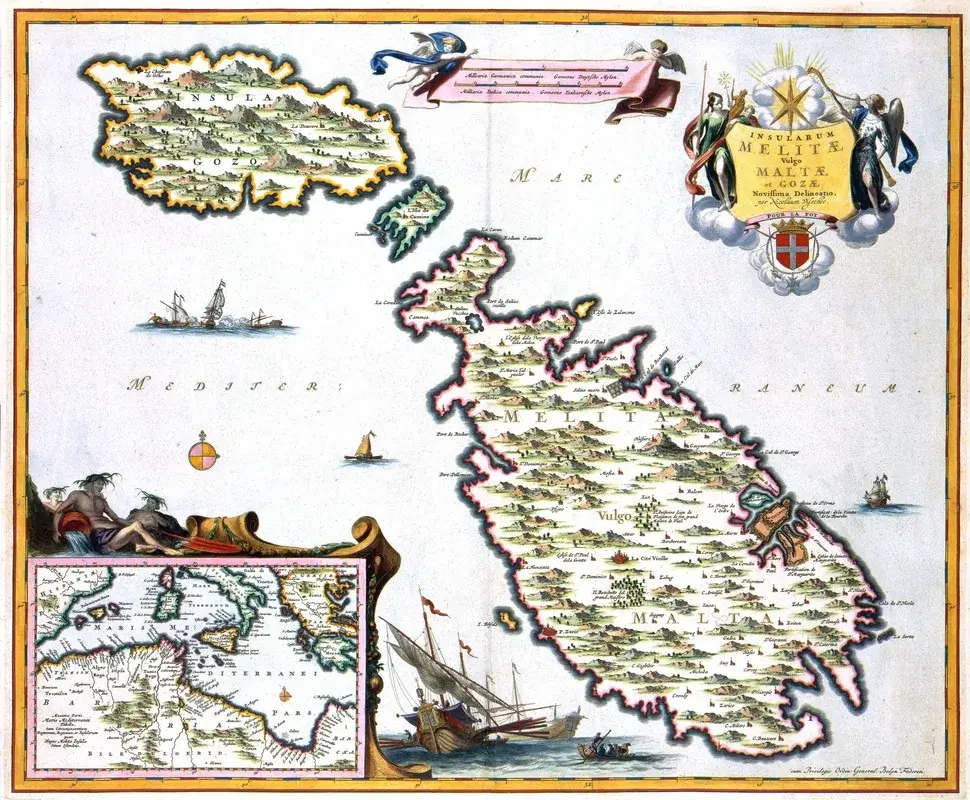
For a country smaller than the Isle of Wight, Malta has absurdly deep history. Temples older than the pyramids, Phoenician trading posts, Roman villas, Arab rule that shaped the language still spoken today, medieval knights, Napoleon, 150 years of british malta, a heroic World War II siege, and EU membership — all stacked on 316 km² of limestone. This guide covers malta history from the earliest settlers 7,000 years ago to the modern republic, told in a way that actually helps you understand what you’re looking at when you visit Valletta, Mdina or the Ġgantija temples.
Malta’s Prehistoric Era — The Megalithic Temples of Malta
Malta’s ancient history is one of the most astonishing in the Mediterranean. The first settlers arrived around 5,900 BC, likely from Sicily, bringing farming, pottery and basic architecture. But the real jaw-dropper comes a few thousand years later: between 3,600 and 2,500 BC, the islands produced the megalithic temples of malta — some of the oldest free-standing stone structures anywhere on Earth.
The Ġgantija temples on Gozo, the Hagar Qim temples, Mnajdra, and the underground Ħal Saflieni Hypogeum are older than Stonehenge, older than the Egyptian pyramids. Built with limestone blocks weighing up to 50 tonnes, some with carved reliefs of spirals and animals still visible today. The Romans later named the island Melita — Land of Honey — partly for its wild thyme and bees, a name that eventually became “Malta”.
Then around 2,500 BC this Temple Period civilisation vanished. Nobody knows exactly why — theories range from climate catastrophe to invasion to resource depletion. The islands sat nearly empty for 500 years before Bronze Age settlers arrived and started again.
Phoenicians, Carthaginians & Romans in Malta
Around 800 BC the Phoenicians — master traders from the Levant — established trading posts across Malta. They gave the island one of its earliest names (“Maleth”, meaning “safe harbour”) and introduced new agricultural techniques and seafaring culture. Their successors the Carthaginians took over around 480 BC and held Malta for over two centuries.
Then Rome. In 218 BC, during the Second Punic War, Rome seized Malta. The islands spent the next millennium as a Roman, then Byzantine, province — a 300-year stretch of malta history that is often skipped but matters: Byzantine Malta preserved Christianity through the turbulent late Empire and held the islands until the Arab invasion. The biggest surviving Roman site is the Domus Romana in Rabat, with preserved mosaic floors. Christianity arrived in 60 AD when the apostle Paul shipwrecked on the northern coast — still celebrated on 10 February as the Feast of St Paul’s Shipwreck.
The Arab Period (870-1091) — How Malta Got Its Language
In 870 AD the Aghlabid Arabs conquered Malta as part of the expanding Islamic caliphate. This is the single most culturally transformative period in the history of malta. Arabic became the spoken tongue, and Maltese today is the only Semitic language written in Latin script — a direct descendant of the Arabic spoken here a thousand years ago.
Place names across Malta are overwhelmingly Arabic: Mdina, Rabat, Marsa, Mellieħa, Gudja. Irrigation techniques, citrus farming, cotton cultivation, the rubble-walled field patterns you see across the countryside — all Arab legacies. Under Arab rule, Mdina became the fortified capital, a role it kept for centuries.
Norman & Medieval Malta (1091-1530)
In 1091, the Norman Count Roger I of Sicily took Malta from the Arabs. The islands passed through Hohenstaufen, Angevin and Aragonese hands as European dynasties competed for the central Mediterranean — a dense stretch of malta history that laid the groundwork for what followed.
The population gradually re-Christianised. European feudal nobility settled the islands. The first serious fortifications appeared around Birgu and the Grand Harbour. By the early 1500s Malta was a quiet outpost of the Spanish Crown — until Emperor Charles V handed the islands to the Knights Hospitaller in 1530 and everything changed forever.
The Order of Malta — Knights of St John (1530-1798)
The order of malta — officially the sovereign military order of malta, also known as the Knights of St John or Knights Hospitaller — arrived in 1530 after being expelled from Rhodes by the Ottomans. For 268 years, the military order of malta ran these islands as an independent military-religious state and transformed Malta from a forgotten Mediterranean backwater into one of Europe’s most fortified and architecturally remarkable territories.
The knights of malta order was founded in Jerusalem in the 11th century as a hospitaller organisation caring for sick pilgrims. Over centuries it became a powerful military force. The order of the knights of malta operated its own navy, minted its own currency, issued diplomatic passports (the military order of malta passport is still recognised today by over 100 countries), and maintained embassies across Europe. The sovereign order of malta remains a recognised sovereign entity in international law, with observer status at the United Nations.
The Great Siege of Malta 1565
The defining event of Maltese history. In May 1565, Suleiman the Magnificent dispatched an Ottoman force of 30,000-40,000 troops to capture Malta. Against them stood roughly 6,000 defenders under Grand Master Jean Parisot de La Valette — about 500 Knights, 4,000 Maltese militia, and a handful of Spanish soldiers.
The great siege of malta 1565 lasted four brutal months. The Ottomans took Fort St Elmo at horrific cost — killing its entire garrison — but couldn’t break the main fortifications at Birgu and Senglea. When Spanish relief forces arrived in September, the Ottomans retreated having lost the majority of their army. The great siege of malta became legendary across Europe; Malta was suddenly Christendom’s southern shield, and millions in donations poured in to rebuild.
Building Valletta
In 1566, a year after the siege, La Valette laid the foundation stone of a new capital on the Sciberras Peninsula. Valletta was the first planned city of the Renaissance — grid streets, modern fortifications, Baroque palaces and churches. The Knights built the Grand Master’s Palace, St John’s Co-Cathedral (with two original Caravaggio paintings still inside), hospitals, auberges for each national langue of the Order. Most of this 16th-century architecture still stands, which is why Valletta is a UNESCO World Heritage Site today.
The order of malta ruled until 1798, balancing its religious mission, naval operations, and — in the final century — slow institutional decline. By 1790 the Order was militarily weakened and financially overstretched.
French Occupation & The Start of British Malta
Napoleon in Malta (1798)
In June 1798 Napoleon Bonaparte, en route to Egypt, demanded to refuel in Valletta. The Knights refused, then surrendered almost without a fight — a humiliating end to their 268-year reign. Napoleon stayed six days, looted church silver, abolished slavery, introduced civil reforms, then sailed on leaving a French garrison behind.
The Maltese hated it. French soldiers plundered churches and taxed heavily. Within months a popular revolt had pinned the French inside Valletta. The Maltese appealed to Britain for help. Admiral Nelson blockaded the harbour. In September 1800 the French surrendered — to the British.
Malta British Colony (1800-1964)
Formally, the Treaty of Amiens (1802) required Malta to return to the Knights. It never did. The British stayed. In 1814 the Treaty of Paris made malta a british colony officially — the start of 150 years of british rule that shaped modern Malta more than any other single period.
The British built naval infrastructure, roads, schools, hospitals and the administrative language framework. English replaced Italian as the official language. The Royal Navy turned Malta into its key Mediterranean base — the island’s economy revolved around the dockyards for generations. The streets of Valletta still drive on the left. Maltese plugs are still British Type G. The malta british legacy is everywhere you look.
Was Malta a British colony? Yes — from 1814 to 1964. Is Malta British? No longer — Malta became independent in 1964 and a republic in 1974. But the British legacy remains pervasive in the legal system, language, driving side, plug sockets and cultural habits.
Malta in World War II — The George Cross
From June 1940, Axis forces subjected Malta to some of the most concentrated bombing in WWII history. The Italian Air Force and later the Luftwaffe flew thousands of missions. Food ran out. Fuel ran out. By mid-1942, the garrison was weeks from surrender.
Then came operation pedestal malta. In August 1942, a convoy of 14 merchant ships fought through the Strait of Sicily under constant attack — six were sunk, six turned back, but five reached Grand Harbour. The tanker Ohio, half-sunk and kept afloat by two destroyers, delivered aviation fuel that literally saved the island.
In April 1942, King George VI awarded the entire population of Malta the George Cross — Britain’s highest civilian honour — “to bear witness to a heroism and devotion that will long be famous in history.” The George Cross is still on Malta’s flag today. Malta world war 2 history is central to understanding the island’s modern identity and its relationship with the UK.
Independence, Republic & EU Membership
After WWII, Malta pushed steadily toward self-rule. Limited autonomy was restored in 1947. On 21 September 1964, Malta gained independence as a Commonwealth realm with Queen Elizabeth II as head of state — celebrated each year as Independence Day. In 1974 Malta became a republic, replacing the monarchy with an elected president. On 31 March 1979 — Freedom Day (Jum il-Ħelsien) — the last British military forces left Malta, ending nearly 180 years of British military presence on the island. This date is a national holiday.
Is Malta in the Commonwealth? Yes — Malta joined the Commonwealth of Nations at independence in 1964 and remains a member today. When did Malta gain independence? 21 September 1964.
The modern Maltese state built itself around tourism, financial services, manufacturing and more recently iGaming and fintech. On 1 May 2004 Malta joined the European Union. On 1 January 2008 it adopted the Euro. When did Malta join the Euro? 2008. When did Malta enter the EU? 2004. Today Malta is one of Europe’s smallest states — and one of its most historically layered.
Historical Sites You Can Visit Today
Abstract history of malta is one thing — standing inside it is another. Key sites for your malta history timeline:
- Ġgantija Temples (Gozo) — 5,600 years old, UNESCO site, outdoor visit ~45 min. One of the megalithic temples of malta
- Ħaġar Qim & Mnajdra (south Malta) — the hagar qim temples cliff-edge complex, best in late afternoon light
- Ħal Saflieni Hypogeum (Paola) — underground prehistoric temple, book 2+ months ahead
- Domus Romana (Rabat) — Roman villa with preserved mosaic floors
- Mdina — the medieval walled silent city, best early morning or after 5 PM
- Valletta — the entire capital is a 16th-century open-air museum; key stops: St John’s Co-Cathedral, Grand Master’s Palace, Fort St Elmo
- Birgu / Vittoriosa — the Knights’ original base; Fort St Angelo, Inquisitor’s Palace
- Lascaris War Rooms (Valletta) — WWII command bunker preserved exactly as it was in 1942
- Fort Rinella (Kalkara) — Victorian British fortress with a 100-ton Armstrong gun
Budget 2-3 days to properly cover the essentials. For organised tours of historical sites, browse our Malta activities directory. If you’re mixing history with beaches and nightlife, our complete Malta holidays guide shows how to split your days.
FAQ — Malta History
Is Malta British?
Is malta british today? No. Malta has been an independent sovereign republic since 1974. But was malta a british colony? Yes — formally from 1814 to 1964. The malta british colony era lasted 150 years and left a deep imprint: left-hand driving, British-style plugs, English as a co-official language, and an enduring cultural affinity with the UK. Is malta a british colony today? No — it’s an independent EU member state.
Was Malta a British colony?
Yes. British malta officially began with the Treaty of Paris in 1814 and ended on Independence Day, 21 September 1964. The malta colony period covered the Napoleonic Wars, Victorian expansion, two World Wars, and post-war decolonisation. When did Malta become British? The British occupation began in 1800 when the French surrendered, but the formal colonial status dates from 1814.
Is Malta in the Commonwealth?
Is malta in the commonwealth? Yes. Malta joined the Commonwealth of Nations at independence in 1964 and remains a member. This relationship reflects the malta great britain historical connection without being a dependency.
When did Malta gain independence?
When did malta gain independence? 21 September 1964 — celebrated each year as Independence Day. Malta became a republic on 13 December 1974, and British forces finally left on 31 March 1979 (Freedom Day).
Who were the Knights of Malta?
The order of malta — officially the sovereign military order of malta — is a religious-military order founded in Jerusalem in the 11th century. They ruled Malta from 1530 to 1798, built Valletta, defeated the Ottomans in 1565 and left an immense cultural legacy. The the order of malta still exists today as a sovereign entity recognised by over 100 states, with observer status at the United Nations and its own diplomatic passports.
What happened in Malta during WWII?
Malta endured some of the most intense bombing of any Allied territory in WWII — from 1940 to 1942, thousands of Axis raids nearly broke the island. In 1942 King George VI awarded the George Cross to the entire Maltese population. Operation pedestal malta (August 1942) — a convoy fighting through to Grand Harbour — saved the island from surrender and helped turn the tide in the Mediterranean.
When did Malta join the EU and adopt the Euro?
Malta joined the European Union on 1 May 2004. When did malta join the euro? On 1 January 2008, Malta adopted the Euro replacing the Maltese Lira at a fixed rate of 1€ = 0.4293 MTL. When did malta enter the eu? 2004, as part of the largest EU enlargement in history.
How old is Malta?
Settled around 5,900 BC, Malta has a continuously documented history of nearly 8,000 years. The megalithic temples of malta date from 3,600 BC — older than Stonehenge and the Egyptian pyramids. The hagar qim temples and Ġgantija are among the oldest free-standing structures on Earth.
What is the Order of Malta passport?
The sovereign military order of malta passport — also called the military order of malta passport — is a diplomatic passport issued by the Order to its officials and diplomats. Unlike a standard national passport, it is issued by a sovereign entity, not a nation-state. The order of malta passport is recognised by over 100 countries for diplomatic purposes. It cannot be obtained by regular travellers — it’s issued exclusively to Order officials and diplomats.
Is the Order of Malta a country?
Is the order of malta a country? Not in the conventional sense — it has no territory of its own (its headquarters in Rome enjoy extraterritorial status). But the sovereign military order of malta is a recognised sovereign subject of international law with observer status at the UN, diplomatic relations with over 100 states, and its own passports and stamps. Is the sovereign military order of malta a country? It’s a unique entity — sovereign but without territory.
→ Planning your visit? Our complete Malta holidays guide covers historical sites, beaches and nightlife in one place