Landing in Malta and not sure what money to bring? Short answer: Euros. Long answer: a bit of context helps, especially if you’re wondering whether the old Maltese Lira still works (it doesn’t), how ATMs compare to exchange offices, and what cash actually buys you on the island. This guide covers everything about malta currency — history, exchange rates, where to get the best deal, tipping rules, and the small money traps that cost tourists unnecessary euros every year.
What Currency Does Malta Use?
Malta uses the Euro (€), just like France, Germany, Italy and 17 other European countries. The country adopted the Euro on 1 January 2008, replacing the Maltese Lira (MTL) at a fixed conversion rate. So if you’re wondering what currency does malta use, the answer is simple: it’s the same Euro you’d use in Paris, Rome or Madrid. One less thing to worry about when planning your trip.
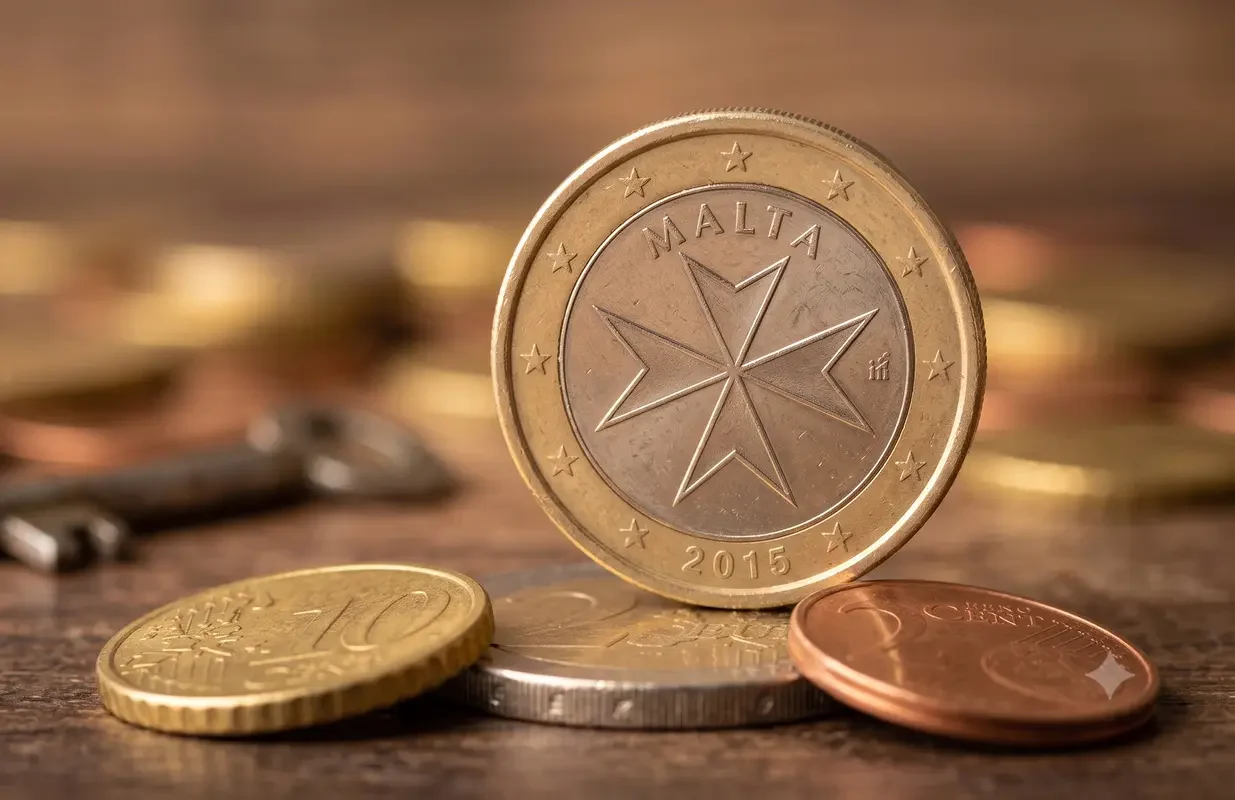
The currency of malta uses standard Euro coins (1c, 2c, 5c, 10c, 20c, 50c, €1, €2) and banknotes (€5, €10, €20, €50, €100, €200, €500 — though €200 and €500 are rare in circulation and many shops refuse them). Maltese Euro coins have distinctive national designs on the reverse — the Maltese cross on €1 and €2, Malta’s coat of arms on 10c, 20c, 50c, and the prehistoric temple Mnajdra on 1c, 2c, 5c — but they’re legal tender across the entire Eurozone, not just Malta.
A Quick History — From the Malta Lira to the Euro
Before joining the Eurozone, the currency of malta country was the Maltese Lira (MTL), also known locally as the Lira Maltija. The malta lira was in circulation from 1972 to 2007, replacing the Maltese pound which had been used under British rule.
Key dates to know:
- 1972 — Malta introduces the Maltese Lira, replacing the Maltese pound
- 2004 — Malta joins the European Union
- 1 January 2008 — the Euro officially replaces the Maltese Lira at a fixed rate of 1 EUR = 0.4293 MTL
- 31 January 2008 — last day of dual circulation (Lira and Euro)
The old malta lira notes and coins are no longer legal tender. If you’ve inherited some from an old trip to Malta, the Central Bank of Malta stopped exchanging Lira for Euros in 2018 — so they’re officially just collector’s items now. The currency of malta before euro can still fetch modest sums among numismatists, especially rare commemorative coins, but don’t expect to trade them at a bank.
Is Malta in the Euro Zone?
Yes. Malta has been a full member of the Eurozone since 2008. If you’re asking does malta use euros or is malta in euro zone, the answer is a clear yes on both. Malta is also part of the Schengen Area and the European Union, which means no border checks when flying from other EU countries, and zero paperwork related to currency when you cross in or out.
Practical consequences for travellers:
- No currency exchange needed if you’re coming from France, Germany, Spain, Italy, Portugal, Netherlands, Belgium, Ireland or any other Eurozone country — just bring what you’d normally carry
- EU bank cards work without foreign transaction fees (check with your bank anyway)
- Cross-border bank transfers within the SEPA zone are free or very cheap
- Malta follows the same ECB monetary policy as the rest of the Eurozone
If you’re travelling from the UK, US, Switzerland, or any non-Eurozone country, you’ll need to convert your money. The next section covers where to do that without getting ripped off.
Where to Exchange Money in Malta
The currency in malta being the Euro means exchange options are everywhere — but not all are created equal. Here’s a ranked breakdown from worst to best value.
| Option | Rate vs mid-market | Verdict |
|---|---|---|
| Airport exchange | -8 to -12% | Avoid unless emergency |
| Hotel exchange desk | -7 to -10% | Convenient, expensive |
| City exchange offices | -3 to -5% | OK if cash is needed fast |
| Banks (Bank of Valletta, HSBC, APS) | -2 to -4% | Reliable, sometimes slow |
| ATM withdrawal | -0 to -2% | Best rate in most cases |
Airport Exchange (Not Recommended)
Currency exchange desks at Malta Airport — like at most airports worldwide — offer terrible rates. Expect to lose 8-12% vs the real mid-market rate. Only use them if you absolutely need cash the second you land and have no card. Better move: use the airport ATM instead (there are HSBC and Bank of Valletta ATMs in the arrivals hall).
ATMs Across Malta (Best Rate)
ATMs give you the closest rate to the real interbank rate, typically losing just 1-2% depending on your home bank. There are hundreds of ATMs across Malta — every town centre, every major street in Sliema and St Julian’s, every tourist zone. Major banks to look for: Bank of Valletta (BOV), HSBC Malta, APS Bank, Lombard Bank.
Tips to save money on ATM withdrawals:
- Always choose “without conversion” when asked — the ATM will offer to convert to your home currency (DCC, dynamic currency conversion). This looks convenient but loses you 5-8% on the rate. Let your bank do the conversion instead.
- Withdraw larger amounts at once — many foreign banks charge a flat fee per withdrawal, so pulling €300 once beats pulling €50 six times.
- Revolut, Wise, N26, Monzo and similar digital banks offer some of the cheapest international withdrawals — often zero fees up to a monthly limit.
Banks and Exchange Offices
If you prefer a counter service, Bank of Valletta and HSBC branches in Valletta, Sliema and St Julian’s handle foreign currency exchange during weekday business hours (typically 8:30 AM-1:30 PM, sometimes reopening in the afternoon). Bring your passport. Rates are decent but not as good as ATMs.
Independent exchange offices in tourist areas (Sliema promenade, Republic Street Valletta, around Paceville) offer mixed value — some are fair, others charge heavy commissions. Always ask for the final amount you’ll receive before handing over your cash, and compare against the posted exchange rate.
Paying in Malta — Cash, Cards & Apps
Malta runs on a mix of cash and card, leaning increasingly towards card as the country modernises. Practical reality:
- Cards accepted in 95%+ of restaurants, hotels, supermarkets, most bars and clubs, taxi apps (Bolt, eCabs), petrol stations and tourist attractions. Visa and Mastercard work everywhere; Amex is less common
- Cash still needed for small local bakeries, pastizzerias (1-2 € for a snack), market stalls in Marsaxlokk, bus tickets paid onboard, some small family-run restaurants, tips
- Contactless payments are standard — Apple Pay, Google Pay, Samsung Pay all work seamlessly
- Tap-to-pay limit is €50 per transaction without PIN
Bring some cash for the first day (€50-100 should cover you), then rely mostly on cards. The malta money situation is broadly similar to any other developed EU country — modern infrastructure, card-friendly, but keep small bills for tips and markets.
Malta Currency to Pound, Dollar & Other Conversions
Since Malta uses the Euro, any standard EUR conversion applies. Rough guide to common rates (subject to daily fluctuation — check XE.com or your bank app for live values):
| From | To €1 (Euro) | Approximate rate range |
|---|---|---|
| British Pound (GBP) | ~£0.85 | 0.82-0.88 typical range |
| US Dollar (USD) | ~$1.08 | 1.03-1.12 typical range |
| Swiss Franc (CHF) | ~CHF 0.96 | 0.93-1.00 typical range |
| Canadian Dollar (CAD) | ~C$1.47 | 1.42-1.52 typical range |
| Australian Dollar (AUD) | ~A$1.65 | 1.58-1.72 typical range |
For British travellers, the malta currency to pound rate matters most. A useful mental shortcut: €10 ≈ £8.50, €100 ≈ £85, €1000 ≈ £850. Rates have been relatively stable recently but check a live rate before large transactions.
Tipping Culture in Malta
Tipping in Malta is customary but not aggressive. Service is rarely included, but tips are usually appreciated rather than expected. Quick guide:
- Restaurants — 5-10% if service was good, round up the bill for casual meals. Check your bill for “service charge” which is sometimes added automatically (usually 10%)
- Taxis — round up to the nearest euro; 5-10% for longer rides
- Hotels — €1-2 per bag for porters, €1-2 per night for housekeeping
- Bars and clubs — €1 per drink if you’re getting several, not expected for single drinks
- Tour guides — €5-10 per person for a half-day tour, more for full-day excursions
- Beach clubs and lidos — tip the waiter serving your sunbed 10% of the bill
American-style 15-20% tipping is not the norm and some servers will actually refuse amounts that feel disproportionate. Keep it modest.
Common Money Mistakes to Avoid
Travellers lose money in Malta the same way they do anywhere — small errors that add up. Five to watch:
- Accepting DCC at ATMs — always decline “pay in your home currency”. Let your bank handle conversion
- Exchanging cash at the airport — as we said above, 8-12% worse than ATM rates. Skip it
- Carrying too much cash — Malta is safe but there’s no point walking around with €500 in notes. Use your card, withdraw smaller amounts as needed
- Assuming cards work in small village shops — most do, but off the main tourist zones (especially Gozo inland, Marsaxlokk early morning markets) always have €20-30 in cash as backup
- Paying tourist prices without checking — in Sliema and Paceville, a pint of local Cisk beer is €3-4 at a local bar, €7 at a beachfront spot. Same beer, double the price. Read menus before sitting down
Plan your spending properly and Malta won’t break your budget. For a full breakdown of what things actually cost, our complete Malta holidays guide covers daily budgets by traveller type. And once you know what you’ll spend on, browse our Malta activities and experiences to book the fun parts in advance.
FAQ — Malta Currency Questions Answered
What is malta’s currency?
Malta uses the Euro (€). It replaced the Maltese Lira on 1 January 2008. One Euro equals 100 cents. Standard Eurozone notes and coins are in circulation, and Maltese Euro coins are legal tender throughout the EU.
Does Malta use British plugs and British currency?
Malta uses British-style three-pin plugs (Type G) because of its colonial history, but it does NOT use the British pound. The country’s official currency is the Euro, full stop.
Can I use US dollars in Malta?
No. You need to exchange dollars for euros. A handful of tourist-heavy shops might accept USD at a bad rate, but everywhere else — restaurants, supermarkets, taxis, clubs — only accepts Euros or card payments.
Is Malta expensive compared to other Eurozone countries?
Mid-range. Cheaper than France, Germany, Italy’s main cities; similar to Greece and Cyprus; more expensive than Portugal and Eastern European Eurozone members like Slovenia. Budget €100-160 per day for a comfortable mid-range trip.
What’s the best way to get Euros before flying to Malta?
If you’re from a non-Euro country, the cheapest approach is: (1) bring a small amount of Euros from your home bank, (2) rely on a fee-free travel card like Revolut or Wise for day-to-day payments, (3) withdraw from ATMs in Malta when you need cash. Avoid bureau de change at your home airport — rates are as bad as in Malta.
Can I still exchange old Maltese Lira?
No. The Central Bank of Malta stopped exchanging Maltese Lira for Euros in 2018. Old Lira notes and coins are now just collector’s items. For official information, check the Central Bank of Malta website.
Is there a minimum card payment in Malta?
Technically no, but some smaller shops, cafés and pastizzerias set an informal minimum of €5-10 for card transactions. For amounts under that, pay in cash or be ready for a raised eyebrow.
What happens if I find old Maltese money?
If you have old malta lira notes or coins from a pre-2008 trip, they’re no longer redeemable. Some numismatic dealers in Malta or online (eBay, collectors’ forums) will buy rare or commemorative pieces, but common coins are worth only their collector value — usually a few euros per set.
→ Need broader info for your trip? Start with our complete Malta holidays guide